Finding my way in deep space |
| More than 20 years
ago, after the localisation of the first deep galaxy clusters up to 1-2 billion lightyears (LY) away, we read about
the 'great wall' (Geller & Huchra 1989). I remember a net of galaxies even resembling some
kind of 'homunculus' (Springel et al 2006). But from an actual point of view, attempts to
recognize any outstanding structures in this filamentous networks
(Ménard, Shtarkman 2022) appear futile. Quasars (most of them about 10 billion LY
away) would be bright enough to be seen all over the universe, but
their 'lifetime' is limited to only 10-100 million years. Thus, I hope for help
by up-to-date celestial positioning systems (CPS) and to keep any smartphone in my pocket after
death... |
| After death? Smartphone? |
| Maybe
you know (or don't you?)
that I do not use mobile phones, not to mention smartphones. You may
also be aware that one of my projects dealt with impressions of cardiac
arrest patients during their 'absence'. A few of them reported
convincingly to have found themselves at some kind of heavenly venue.
This experience makes me think now and then, whether something similar
could happen also to me (not that far-fetched at my age). |
| Provided
I had a phone on me,
even equipped with the appropriate CPS, I could - lost in
deep space - simply entrust this app with my earthern address. Before
turning to quasars, it may first screen the local microwave background anisotropies
to get a first rough idea of where we were. Only then, after a minor
translocation into the indicated district, the small device would shift
between 3 or 4
far-distant but prominent quasars, before directing me to a flock of
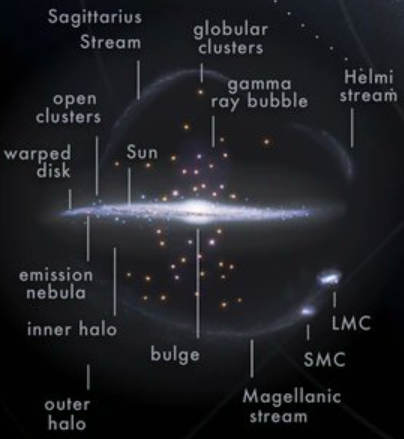
galaxy clusters. After a few minutes, a view like shown above would
take away my breath. |
| Since this view would miss the signposts given above, it
would still take a while for
the app to find our good old milky way among 100 billion other solar systems, but
finally all details might fit, including the number of planets, the
rings around the 6th, and the moon close to the blue earth. Then I
could have a look at the places I used to know in my lifetime. I would
be eager to find the apartment I was used to live in. What would I find
there? My desperate children trying to get rid of the useless plunder I
left behind? |
| I
would be inclined to advise them what to do, but they would not hear
me. Also attempts to help them secretly would fail. Finally, I would
sit in the moon's crescent, sad and sorrowful. What went wrong? Where
was my company? Didn't our patients tell me about deceased close relatives who
awaited them joyfully? I would turn around, overwhelmed by myriads of
stars
glittering all over the black sky. |
| 10/26 < MLB > |
| MJ Geller, JP Huchra (1989) Mapping the universe. Science 246, 897-903 V Springel, CS Frenk, SDM White (2006) The large-scale structure of the universe. Nature 440, 1137-44 B Ménard, N Shtarkman (2022) The map of the observable Universe, Johns Hopkins University
|