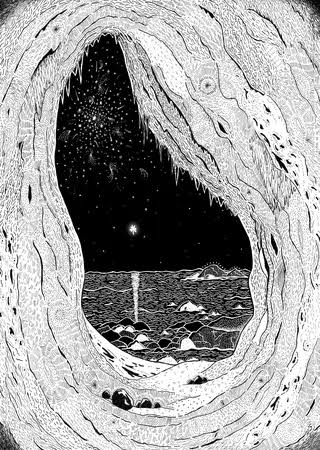
Beyond our phantasy
|
The
first stars of the universe came to light out of the primordial
gases H2 and He, starting at about 1/10th of the first billion years.
Compressed by gravity, heavier
elements were generated by fusion, setting free enormous amounts of
radiation energy. Due to the instability of the Beryllium-nucleus, the
fusion process got really going only at temperatures allowing the triple-alpha process
to go directly from He to C. On the background of bulk
carbon, nucleosynthesis proceeded (by single-alpha addition) to the even-numbered elements O,
Mg, Si, and S.
|
These first-generation stars
reached masses several 100 times heavier than our sun, untill they
finally exploded as extremely dynamic supernovas after about 2/10th to
4/10th of the first billenium. The debris was spread into the pristine
intergalactic medium, seeding the voids between the proto-galaxies
with the first heavier elements. From this mixed-through dust,
2nd-generation stars formed with masses similar to our actual worlds.
Most of these were CEMP stars, rich in carbon and poor in elements
heavier than S.
|
The
further fate of the universe was mixed. A majority of these
2nd-generation stars was big enough to continue nucleosynthesis to
heavier elements and developed once more into supernovas (within 1-5
billion years),
but a small decent minority stayed calm and modest in the background,
with masses lower than our sun. To this date, they spend their 'living'
in the halo also of our milky way, at a distance of a few hundred
lightyears (LY) from our earth. The chances that we ever learn details from these sytems are bleak. At least, we can try to model them.
|
Although the boundary conditions
for the evolution of eventual life were very different from those on
our early earth, the stage was highly divers. We should imagine a
multi-facetted dynamic system receiving a substantial and reliable
influx of energy. Such conditions induce steady states and repetitivly
changing patterns of activity (dissipative processes). If such
phenomena develop units with some stability replicating themselves, we may call them a form of life.
|
On CEMP planets, these life
forms must cope with the chemistry, atmosphere, radiation and geology
encountered. First lessons from such unusual conditions may be taught
by Saturn's moon Titan, not hundreds of LY away, but just 1.2 to 1.7 billon km (for light just a mere 1-1½ h). 'We' have been there already in 2005. 'Living
cells' in a sea of methane and ethane? Good luck. Even more than 13
billion years of evolution may not teach such a trick. Or may they?
|
Keen scientists didn't need billenia to come up with sound propositions: the azotosome,
the self-associating building block acrylonitrile was even detected in
Titan's atmosphere. Nucleotides without phosphate and ribose? Peptide Nucleic Acids (PNAs)
could jump in (with the help of a bit O). In more than 13 billion
years, nature might come up with more brilliant ideas than we can imagine.
Of course some sort of life would evolve also on small CEMP planets.
|
Some kind of bio-metabolism could address the atmospheric CO, vaguely reminiscent of our photo-synthesis.
On earth, Mg2+ plays a central role in that respect. CEMP planets
harbor robust amounts of it. Any pseudo-organic complexes formed by
Mg2+ and N-containing heterocycles would, over the billenia, learn how
CO is fixed from the atmosphere and how it could be used for essential
processes. N would be much easier recruitable for pre-biological needs
than the inert N2 dominating the earthen atmosphere (the CEMP planets'
atmosphere is expected to contain NH3 and HCN).
|
Instead of phosphorous, sulphur might be used to store energy in bonds with O. Over the billenia, the unabating influx of meteorites will slowly change the status of such heayy metals as Fe, Ni and Zn from absent to trace elements.
While on the early earth they were mobile salts dissolved in the
archaic (aequous) ocean, they would on carbon planets form neutral
complexes, moving freely in apolar milieus as methane and ethane. They
would facilitate the transfer of electrons in chemical reactions.
|
Maybe these
planets would be covered with woods made of graphen nanotubes and
nanosheets, with robust and sturdy carbon fiber trunks. Maybe nanotubes
would conduct UV-light or electricity through the sub-ground rizome. In
any case: 'something' would be living on these planets. Probably it
would be a slow life more reminiscent of plants than of animals. Maybe,
in 13 billion years, even intelligent plants did evolve, beyond our
phantasy. /\
|
10/26 < MLB (10/26) > 10/26
|