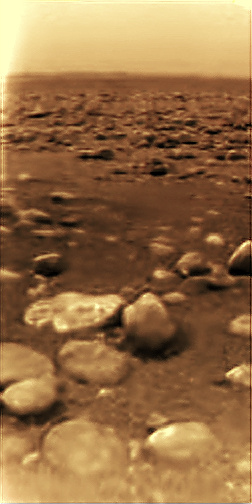
photograph by Huygens (contrast enhanced).
|
Saturn's biggest moon Titan was dicovered by Christiaan Huygens
in 1655 with a telescope containing two refracting
lenses ground and polished by himself. The probe reaching
Titan's surface in 2005 was named after him. photograph by Huygens (contrast enhanced). A dry primordial anvil |
| While
life ultimately thrived in an aqueous matrix, the fundamental organic
building blocks of our genes may have been forged in the young universe
under non-aqueous conditions. What
kind of molecular reactions
can be expected on the surface of the first CEMP planets? How H, C, N,
O, Mg, Si, and S might have interacted? Due to their relatively low abundance
in this '2nd generation world', O and Si would have played no central role
(as on the prebiotic earth). C would have dominated the scenery and
created a very special hydrocarbon world under heavy UV-bombardment. |
| On the surface of the first Carbon-Enhanced Metal-Poor (CEMP) planets, other synthetic opportunities opened up than on the early Earth. Because CEMP systems possess high C to O ratios (> 1), oxygen is entirely locked up in carbon monoxide (CO), with little left to form water or silicates. The atmosphere is highly reducing, dominated by methane (CH4), nitrogen (N2), CO, hydrogen (H2), and some H2S (increased by eventual volcanism).The solid ground is dominated by graphite, long-chain hydrocarbons, and carbides. Mg will not find enough O and silicates to take over its usual role as divalent cation and will be available for organo-metallic reactions. |
| In the absence of earth-typical clay minerals and quartz, silicon carbide
(moissanite - on earth only found in asteroids) would serve as the main
rock-forming mineral, accompanied by Ti- and Ca-carbides, Mg- and
Ca-sulfides, and plain and simple graphite.
Liquid water may have survived in a few niches, leaving most of
the stage to liquid methane, ethane, and formamide. Mg lost
its typical role in silicate minerals
to teaching
us a first lesson in Grignard
metallo-organic chemistry: In the absence
of water, it can insert into carbon-halogen or carbon-nitrile bonds. UV
light promotes the formation of radical species, enabling reactions
like R–CN + Mg + hv » R–C(Mg)=N⋅ . These intermediates act as highly
reactive nucleophiles, establishing new covalent C-C bonds.. |
| Also
without the detour via metal-organic bond formation (in presence
of too much moisture), Mg2+ ions readily coordinate with nitrogen in
nitriles, polarizing the CN-triple bond and thereby significantly
lowering the activation energy required for nucleophilic attack,
allowing nitrogen-heterocycles like purines and
pyrimidines to be formed from cyanides. Under heavy UV flux, H2S and
acetylene (HCCH) may react to yield small aromatic heterocycles as
thiophene and thiazoles. Environmental conditions as
moisture, temperature, pressure, surface, radiation intensity, and time
would decide which pathways come into play. |
| Photolysis of the methane-rich atmosphere by stellar UV radiation
yields massive quantities of hydrogen cyanide (HCN) and formaldehyde
(HCHO). As first proposed by Carl Sagan, these compounds polymerize in the atmosphere into complex
organic aerosols called tholins (derived from old Greek for 'muddy'; Sagan & Khare 1979),
which rain down onto the surface (as on Saturn's Titan). Among other
products, also
diaminomaleo-nitrile (DAMN) may form. On further photochemical
processing, amino acids and nucleobases may ensue. But not always
hydrocarbon strategy will follow Titan's (very cold) example. Titan's
geology is dominated by stony water ice (see photograph at top), much in contrast to CEMP
planets. |
| Organic
chemistry is the strength of a hydrocarbon world under UV-influence in this act one of the Ludus vitalis.
In
the absence of water, long chains of simple heterocycle units may form
and persist. In a hydrophilic milieu, chain elongation is often
followed by fast hydrolysis (i. e. cleavage by the addition of H2O),
not allowing for significant growth. In an apolar environment, first chains probably grew on
supporting surfaces as graphite. Over the millenia, chains
learned to grow faster along other chains, creating the first bulk
amounts of pre-bio-organic matter. This probably marks the dawn of pairing
certain heterocycles vis-a-vis each other. Base-pairing hydrogen-bonds would even be stronger in a hydrophobic milieu (the interior of the modern doublehelix is still free of water). |
| On the surface of CEMP planets,
heterocycles may form in hydrocarbon seas, supported by graphite
surface, Mg, and UV. But how could they form chains? In modern
polynucleotides, this is accomplished by ribose and phosphate, both
inaccesible in a hydrocarbon world. 'Prebiotic Peptide Nucleic Acids (PNA)'
use an uncharged, pseudo-peptide backbone, chaining genetic information
together without ribose or phosphate. PNAs have first been described by
Nielsen et al (1991). It has been hypothesized that on the early earth
a 'PNA world' has preceded an RNA world, before the advent of DNA and protein. |
| Probably
this was the endpoint
of pre-bio-evolution under 2nd-world premisses. One element indispensible
for life as we know it was sparse in the primordial carbon-world:
phosphorus. Phosphate and ribose as linkers of heterocycles need water. Whether
single
self-replicating and closed entities ('cells') are possible in a
hydrophobic milieu is a matter of debate. In any case, act two in this Ludus vitalis was played out in the next (3rd) generation of solar
systems, this time under 'high metal' conditions in an aequous milieu. Probably the primary
organic building blocks bred in act one were robust and abundant enough to survive the turbulent change of stage. |
| The step-wise evolution of
prebiotic material may have taken place already in the 2nd and 3rd
generation of solarsystems, long before the end of the first billion
years. The 1st step ended with supernovas of 2nd generation
solarsystems, distributing dust containing more heavy metals than the
first series of explosions, but also first pre-biotic
material forged on carbon-dominated planets. The 2nd step went on with
this pre-organic material in aequous worlds. The primordial cosmos with
its short distances might have resulted in a universal genetic alphabet, with diversity setting in during the 2nd step leading to the first life forms. |
| 9/26 < MLB (10/26) > 10/26 |
| Nielsen PE,
Egholm M, Berg RH, Buchardt O (1991). Sequence-selective recognition of
DNA by strand displacement with a thymine-substituted polyamide. Science. 254, 1497–500 Sagan C, Khare B (1979) Tholins: organic chemistry of interstellar grains and gas. Nature 277, 102-7 |
| I thank google KI for support during the preparation of this essay. |