calckit.io
< Afterglow >
|
| While
in private life we all welcome to be free and self-determined, in
mathematical issues freedom is often the source of hardship
and pain, especially if it comes to the solving of tedious equations.
The more 'degrees of freedom', the higher the hurdles to be taken to a
clear solution. In essence, equations consist of parameters, variables,
and more or less common operators. Often, demanding tasks consist of
several equations related to each other. |
| An equation describes how a
certain figure depends on specific parameters. The area of a
rectangle can be obtained by multiplying the length of its sides
with each other. Unfortunately, it is not always as easy as that. The
really interesting equations usually contain more unknown than known
parameters. The aim of the procedure would be to get hold of the
unknowns (the variables) and express them in terms of their relationship to the known ones. |
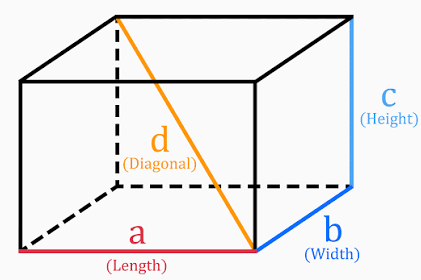
| Lets now imagine a
cuboid with the sides a, b, and c (as the one above). Its volume
can be calculated by multiplying a with b and c. If the length of all
sides was known (e.g. V = 10 * 20 * 30), this equation has just one
clear result (V = 6 000) and enjoys no freedom at all. If the length of
one side is not known (e.g. a), the equation would read V = a * 20 * 30 = 600 * a.
No single result could be obtained, but at least we know that multiplying a with 600 gives the Volume. In this case, the equation is stated to have one degree of freedom. |
| Each
additional degree of freedom moves us one step away from a clear
result. If we now try to discuss mathematical evaluations in an
event space with more than 4 dimensions, we should expect quite a few
degrees in addition. Three further dimensions to
be explored may lead us in rough seas. Our first impression might be
that we cannot get any vague result (not to mention clear ones).
However, if we compare different societies with each other, some
regularities might appear. |
| The
'social' dimensions 4, 5 and 6 (I prefer to range time at the end of
the list, position 7 or even 10) will span some kind of 'social space',
like the dimensions 1, 2 and 3 span the physical one. The
what- and how- and wherabouts of various societies might internally for
each of them follow regularities and patterns. 'Laws' and predictions
may be derived from empirical material as it is (with much higher
precision) possible for the physical space. |
| To
make reality complete, we
still miss the final three dimensions. If they are an indispensable
ingredient of our every day life, we should be able to explore also
these last principles of the world. Since my first speculations about
this strange subject in 1989, I suspect that they are the source of art
and wisdom and drive our aspiration to high achievements. Our late head of department Oleh Hornykiewicz used to say that our discoveries just find something hidden in a secret place where it patiently waits to be revealed. |
| We may not
only receive our inspirations from there, but may also feed into this
recevoir our creative thoughts and imaginations, even without
converting them into words, tunes, carving or painting. Maybe it was Brahms who said, that forgotten melodies always come back more beautyful than before.
Our milky way consists of about 100 billion solar systems, making it
likely that it was and is populated by many other civilisations like ours. Furthermore, the universe contains once again 100 billion other galaxies. |
| Our
'higher feelings' may be just the afterglow of a presence preceding and
accompaning ours. They may be subject to other rules and limitations
than our conventional spacetime. |
| 7/26 < MLB > 7/26 |
|
Cosmic Feelings?
|