Extraterrestric habitable worlds |
| Giordano Bruno made it to the stake in 1600, claiming the existence of multiple worlds populated similarly to ours with plants, animals and intelligent beings. This claim alone would have probably not entailed such harsh treatment, but he also held opinions contrary to core Catholic concepts as the Trinity and the deity of Christ. Although he stepped back from these latter positions during his trial, he persistantly kept to his cosmological views (unlike Galileo decades later). His trial lasted for 7 years. He was inclined to harsh, non-diplomatic outbreaks, and this probably tipped the scales. Still in 2000, the Vatican refused his rehabilitation. |
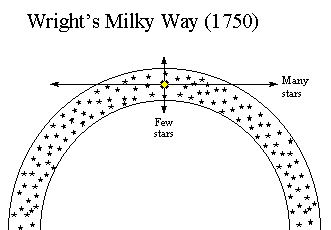
| It took 150 years until the English astronomer Thomas Wright recognized (1)
that the solar system belonged to a huge aggregate of similar systems,
with the densest part visible as 'milky way' on the night sky. In 1751, Immanuel Kant
(*1724) read an article in a newspaper about Wright's book and was
inspired to his Allgemeine Naturgeschichte und Theorie des Himmels (2)
without, however, daring to indicate his name. It appeared risky to
him, to suggest in the public the development of the universe without
the need of a creator. Both speculated that 'nebulas', seen as simple
clouds of dust at their time, were other milky ways at a very far
distance. |
| Since this could not be verified with the available instruments, the idea fell into oblivion for quite some time. Only in 1924, Edwin Hubble proved
the hypothesis that nebulas (some of them visible to the naked eye) were remote galaxies.
About the same time new estimates on the number of stars in the milky
way didn't simply scale up the number of bright dots in a particular
area of night sky to the whole observable sky around the earth, but
operated with total brightness and mass distribution, arriving at about
100 billion (E11). Modern results exceed this number only by a factor
of ca. 2. |
| Concerning the number of galaxies in the universe, counting results improved just recently, with the implementation of powerful instruments as the Hubble and the James Webb telescopes in outer space. Hubble in the 90ies returned by accident a number similar to the number of stars in the milky way (100-200 billion). This would result in a total number of stars in the universe of at least 100 billion times 100 billion (E22), as proposed by Carl Sagan already in his 1980-book Cosmos. The first James Webb results gauge this number further up by at least one order of magnitude, due to many small early systems overlooked in less powerful surveys. Whether life forms could be expected also at this very young age of the universe is an open question. |
| It
took some time to form heavier elements from the primordial hydrogen,
helium and lithium. With the formation of carbon, oxygen, nitrogen,
silicon, and even iron still within the first billion years, all
material deemed necessary for 'stony planets' was
present. It
appears likely that most new discoveries by the James Webb telescope
concern 'worlds' with rather 'toxic' and turbulent conditions, missing
some trace elements indispensable for photosynthesis and other
essential activities. A conservative estimate of habitable
worlds should probable stay with the Hubble-numbers from
the 90ies. |
| Kant's
contribution to cosmology remained limited. Due to a fire accident, the
1755 edition of his (anonymous) book was almost completely lost. In
1791, Allgemeine Naturgeschichte und Theorie des Himmels appeared
together with 3 seminal studies by William Herschel under the title Über den Bau des Himmels,
edited in Königsberg. In these
studies, the German/English astronomer had recorded the 3-dimensional
position of a great number of stars, confirming their disk-like distribution as had been suggested much earlier by Wright & Kant based largely on intuition and Newtonian gravimetrics. |
| In the meantime, Kant had switched from natural science to epistemology. He had to find out that 'pure thinking' was not so easy as he might have expected. Only under the influence of David Hume putting more weight on the sceptical scrutiny of experience and custom, he was able to complete his Critik der reinen Vernunft in1781. It took him 6 years to revise it to the more successful 2nd edition (1787), swiftly followed by Critik der practischen Vernunft (1788), with the Beschluss: „Two things fill the mind with ever new and increasing admiration and awe, the more often and steadily we reflect upon them: the starry heavens above me and the moral law within me. ...“ |
| So, Kant may have spent most of his time with thinking, but he never forgot the overwhelming impression of a clear night sky. And even he 'made it', not to the stake as Bruno, but to the Index Librorum Prohibitorum with his Critik der reinen Vernunft in 1827 - after a peaceful death. /\ |
| 9/26 < MLB (9/26) > 9/26 |
| /\ (1) Thomas Wright (1750) An original theory or new hypothesis of the universe. London, England: H. Chapell. /\ (2) N.N. (1755) Allgemeine Naturgeschichte und Theorie des Himmels, oder: Versuch von der Verfassung und dem mechanischen Ursprunge des ganzen Weltgebäudes nach Newtonschen Grundsätzen. Königsberg und Leipzig, bey Johann Friedrich Petersen. |