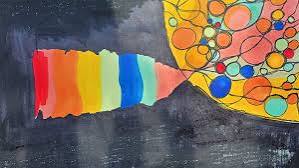
Andrea Perschl
Ludus vitalis |
| Numerical simulation and recent observation by the James Webb telescope suggest an unexpected playground for Manfred Eigen's Ludus vitalis. The first solar systems formed after the dust expelled by supernovas of generation one stars had settled.
The 2nd generation systems formed from this dust run under the acronym CEMPs
(carbon-enriched metal-poor) and are hot candidates for the first with
stony planets (although poor in silicon and iron). |
| Carbon occupies a Janus-faced position in the dance of the first elements. As for today, it is the fourth most abundant element in the universe by mass, after hydrogen, helium, and oxygen (Wiki). It can stand alone as a mineral in coal (up to 90% C) and pure allotropes as graphite,
diamond, graphene and others. Carbon atoms have a tendency to self-associate,
forming the backbone for an extremely diverse plethora of organic
compounds. They often build rings, sometimes incorporating
heteroatoms as N, O, and S. Adenine, thymine, cytosine and guanine
at the core of earthern genetics are such heterocycles. |
| Nuclear-physical necessities during the generation of increasingly heavier elements in the
first stars decided on the mixture of elements forming the first
planets and set the stage for the Ludus vitalis.
I learned from the internet that nuclei of Beryllium (the fourth
element) arising by conventional fusion processes lack stability and do
not lend themselves for further progress towards heavier elements. One way
around this bottleneck is the instantenous fusion of three
4He-nuclei to yield (perfectly stable) carbon. |
| The
result of this Be-anomaly is (1) the low abundance of this element, and
(2) low abundance of Li and B too, that are skipped in this
'triple-alpha process' (4He consisting of 2 protons and 2 neutrons is
called 'alpha particle'). So, nature had to play around without boron
(in retrospect no great loss, since most organic compounds with B lack
chemical stability). Nucleosynthesis continues after carbon further
with the addition of single 4He units, resulting (3) in higher abundance of
even number elements as compared to odd number ones (Oddo-Harkins rule). |
| After
C, also O, Mg, Si, and S take advantage from this deep stellar
peculiarities. Third generation solar systems (as ours) formed with
proto-planetary dust disks containing more Si than C (yielding
Earth's Si-dominated outer crust). In the early universe, this ratio
was reversed, yielding rather exotic landscapes based largely on
carbon. Furthermore, the environment was probably dominated by
carbon-based liquids instead of water. Titan, the largest moon of
Saturn, displays lakes containing methane and ethane. |
| What a strange stage for a Ludus vitalis.
Maybe it would be worth while to conduct experiments as those by Miller
& Urey (1952) under the exotic conditions
of a 'carbon world'. The scenery was illuminated by light with a
prominant UV-content. Surfaces were layers of graphite presenting
aromatic pi-electrons. The unsurmountable challenge of this type of
experiments is the time scale: we cannot artificially turn it forward. |
| I would expect self-replicating processes under both conditions
(hydrophilic and hydrophobic ones). Both conditions would address
seperately the two levels (genes versus function). The details will
most likely differ. Maybe under hydrophobic conditions, in close contact with surfaces presenting pi-electrons and under intense
UV-influence, statistics would decide for more robust genetic
building blocks. |
| Such
carbon-world life might stay limited to surfaces and not proceed to
multicellular forms.
Or - on the contrary - the chemistry of our actual genes and functions
was originally outplayed on exactly these strange anvils,
organic solvent and active surfaces facilitating and accelerating the
optimization. Short distance to neighboring solar systems and high
frequency of catastrophic collisions may have done the
rest: fast distribution to most carbon worlds at this time. Such a
spread
might have resulted in a common fundamental chemistry of all
life forms in the
universe.
/\ |
| 9/26 < MLB (9/26) > 9/26 |
| M Eigen & R Winkler (1973//74) Ludus vitalis. Boehringer Mannheim, Mannheim |